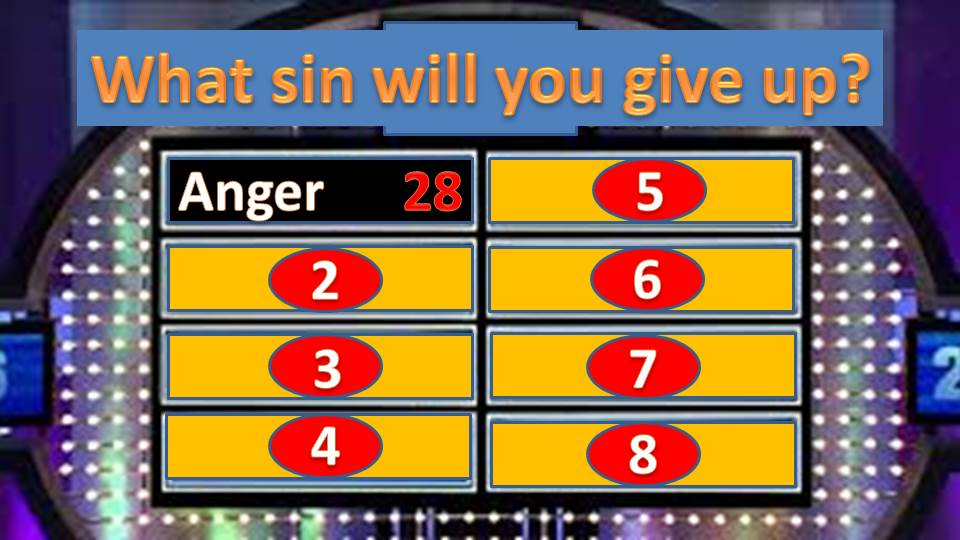
On Ash Wednesday, Liberty Chapel worshipers were surveyed with this question: “With God’s help, what sin will you give up?” Twenty-nine percent responded with the number one answer– “anger”. Is there help for this pervasive problem?
The Bible says, “‘In your anger do not sin’: Do not let the sun go down while you are still angry, and do not give the devil a foothold. . . .Do not let any unwholesome talk come out of your mouths, but only what is helpful for building others up according to their needs, that it may benefit those who listen. . . .Get rid of all bitterness, rage and anger, brawling and slander, along with every form of malice (Ephesians 4:26-31–ESV).
Anger is neither good nor bad since emotions are neutral in their moral value. The behavioral response to anger is where the moral value lies. In response to anger, behavior can be a good thing. On the court, anger might give energy to play aggressive basketball. In the community, anger can yield energy to bring positive change.
Behavioral choices can also be bad or sinful. On the basketball court, out of control rage can lead to undisciplined actions which result in stupid fouls and blown plays. In life, when a person is attacked rather than an issue or when out of control behavior disrupts a relationship, that is bad. When unintended consequences are worse than the original problem, that is sinful.
James advises, “Know this, my beloved brothers: let every person be quick to hear, slow to speak, slow to anger; for the anger of man does not produce the righteousness of God. (1:19-20–ESV).” As I read that, I could hear Dr. Phil ask, “How’s that working for you?” Rather than solving a problem, an outburst of anger usually worsens the situation.
James adds, “What causes quarrels and what causes fights among you? Is it not this, that your passions are at war within you? You desire and do not have, so you murder. You covet and cannot obtain, so you fight and quarrel. You do not have, because you do not ask. You ask and do not receive, because you ask wrongly, to spend it on your passions (4:1-3–ESV).”
Many times, anger issues are based on stuff. Loving people and using things is a successful strategy, but it never works when you use people and love things.
The fourth century desert Father John Cassian writes that anger is a “a rancorous spirit against those who have upset us. Any kind of rage drives the Holy Spirit away from us. The remedy is to cut out wrath and anger from our lives. The only anger allowed is against our own sinfulness.”
Some anger management techniques may be helpful:
Take some time to think before you speak. Daniel Tiger says: “When you feel so mad you want to roar, take a deep breath and count to four.”
“I” messages are helpful. “I am frustrated when I am late to an appointment” is more helpful to anger management than “you make me late”.
Focus on possible solutions rather than what cause the anger. Rather than venting anger at your tardiness, it might be helpful to ask, “What can I do next time that will help us to be more punctual?”
Forgiveness is a powerful thing. Do not hold grudges. If one focuses on anger and negative feelings instead of positive things, one can become stuck in bitterness.
Know when to seek help. Anger management is a challenging skill to learn. If you have a problem that seems insoluble, seek someone who can suggest other possible solutions. If your anger drives behavior that consistently harms your relationships or produces regretful actions, find a teacher who can help you learn to manage your anger.
In dealing with anger management or any sinful behavior, the battle is fought on two fronts. There is an emotional battle, and to succeed in this arena, one will need focused effort involving self-improvement and self-control. There is also a spiritual battle which calls for the sanctifying power of the Holy Spirit who changes attitudes and behavior.
Edwin Hatch writes: Breathe on me breath of God Till I am wholly thine, Until this earthly part of me Glows with thy fire divine
[This article will be published in the Liberty Press this week. It was condensed from yesterday’s talk.]





 The farthest star from Earth, with the highly imaginative name “SDSS J122952.66+112227.8″, is 55 million light years from earth. Since a light year equals 5.88 trillion miles, this star would be 323.4 million trillion miles away. If you got in the minivan and began to drive there, and if your children would ask, “Are we there, yet?” once every five miles, you would be certifiably insane before you got to Jupiter, so it doesn’t matter that they would repeat that question almost 65 million trillion times on the entire journey.
 They bound the hands of Jesus
 This has been a weird winter. The cold weather and snow came late, but when they arrived, they never wanted to leave. Several Sundays were impacted by slippery roads, and several school days were canceled. The polar vortex gripped us for a week and brought thirty-year low temperatures. Even the groundhog did not do us any favors. Although he did not see his shadow, the corner spring is just around seems further away this year. When the thermometer reached the 60’s, it was quickly followed by snow covered mornings. Will spring ever come? The good news is this: Easter will come!


 Neither Life Nor Death